A solar-plus-storage site has more vendors than people on site. You'll find photovoltaic (PV) inverters, a meteorological (met) station, trackers, a battery energy storage system with its own battery management system (BMS) and power conversion system (PCS), enclosure HVAC, a fire and gas panel, and increasingly EV chargers too. Each one exposes its data differently, and most of these sites are unstaffed.
The energy management system (EMS) needs all of it on one timeline, plus a safe way to send set-points back. That's the job of an edge gateway, the edge device that sits between the field equipment and the dashboard.
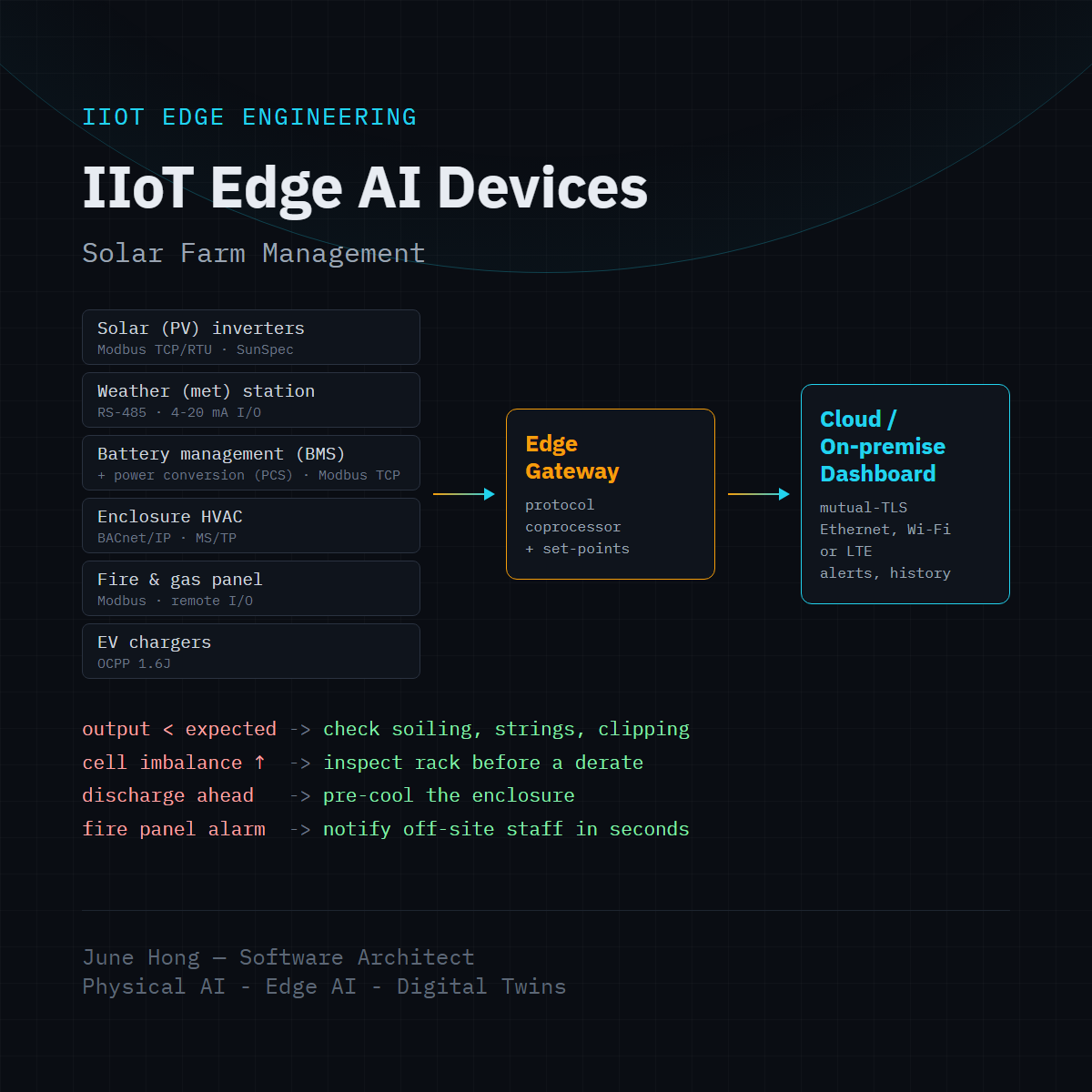
Fig. 1 — Field data from a solar-plus-storage site flows through an edge gateway to a cloud or on-premise dashboard
Getting the Data Off the Site
An edge gateway paired with a protocol coprocessor speaks the industrial protocols the site already uses. It can read field devices, and write set-points back to them where the device allows it.
| Source | Protocol | Typical data points |
|---|---|---|
| PV inverters | Modbus TCP / RTU (SunSpec register maps) | DC string voltage and current, AC active and reactive power, energy totals, fault codes |
| Met station and trackers | Modbus RTU on RS-485, or 4–20 mA through a remote I/O module | Irradiance, module temperature, wind, tracker position and stow state |
| Battery BMS and PCS | Modbus TCP | State of charge (SoC), state of health (SoH), rack temperatures, cell imbalance, PCS mode and output |
| Enclosure HVAC | BACnet/IP, BACnet MS/TP, Modbus | Cooling status and set-points |
| Fire and gas panel | Modbus, or remote I/O on the panel's auxiliary outputs | Alarm, trouble, and supervisory states, gas levels |
| EV chargers | Open Charge Point Protocol (OCPP 1.6J) | Charger status, sessions, meter values |
One more source matters a lot in practice: an on-site EMS that has no remote access of its own. If it exposes its data and set-points as a Modbus TCP server, the gateway polls it like any other device. The EMS keeps making its real-time decisions on site, and gains a remote dashboard, alerts, history, and remote schedule changes without being rewritten.
Getting the Data Out Safely
The gateway connects to a cloud or on-premise dashboard over TLS with mutual certificate authentication. Each device has its own X.509 certificate, so only provisioned gateways can connect, and every reading can be traced to a specific site and device.
The uplink follows the owner's IT policy. Where a site network is available and approved, the gateway uses Ethernet or Wi-Fi. Where the owner wants monitoring kept off their network, or the site is remote, a cellular variant uses its own LTE-M / NB-IoT link. It only makes outbound connections, so it opens no inbound path from the internet into the site.
From One Timeline to Real Site Management
Once the data is in one place, management gets concrete:
| What's watched | Trend or event | Action |
|---|---|---|
| Inverter output vs. met data | Output falls below what irradiance and temperature predict | Check for soiling, string faults, or clipping |
| Battery racks | Cell imbalance or temperature spread grows on one rack | Schedule an inspection before it becomes a derate |
| Battery + HVAC | A high-power charge or discharge is scheduled | Pre-cool the enclosure instead of running HVAC hard afterward |
| Fire and gas panel | Alarm or trouble state | Notify off-site staff in seconds, with site context |
| Meter, BMS, PCS, tariff | Peak demand or a price signal | The EMS sends charge/discharge set-points to the PCS |
| Chargers vs. solar and storage | Charger load rises | See it against available solar output and battery SoC |
Most of these aren't neural networks yet. They start as trend rules, because trends are cheap, explainable, and useful from the first week. Edge AI comes next, once months of history show where a fixed threshold stops working. Two good first candidates are a learned baseline of normal inverter output for each weather condition, and anomaly detection on battery cell data that catches drift before it reaches an alarm limit. I wrote more about that trade-off in Traditional Algorithms vs. Edge AI Models.
Carbon Credits: The Overlooked Revenue
A solar, storage, and EV charging site produces clean energy, and its chargers displace fossil fuel. Several kinds of program turn that into tradable credits or certificates:
- Low-carbon fuel credits for EV charging, such as California's Low Carbon Fuel Standard (LCFS), Canada's Clean Fuel Regulations, and Germany's GHG quota. They are earned on the kWh delivered to vehicles.
- Renewable energy certificates for metered solar generation: RECs in North America, Guarantees of Origin in Europe, and I-RECs in many other markets.
- Corporate emissions and ESG reporting, which needs generation, self-consumption, and grid import/export data even where no credit is traded.
Every program asks for the same thing: measured, time-stamped energy data that an auditor can trace to a specific device. A gateway that already reads the meters and chargers, and identifies itself with its own device certificate, can supply that data. That can turn a monitoring project into a recurring revenue stream. Eligibility and credit value depend on the program, the region, and who owns the equipment, so each project should confirm them with the program administrator or an aggregator.
Three Principles I'm Building In from Day One
- Put each control function where its response time belongs. Grid protection, anti-islanding, battery protection, and fire shutdown run in milliseconds inside certified equipment. A round trip to the cloud, especially over cellular, takes hundreds of milliseconds to seconds. That's fine for dispatch, arbitrage, and peak shaving, and far too slow for grid protection. The gateway monitors the safety systems and never replaces them, which is also what lets it be added without re-certifying the site's protection scheme.
- The gateway is not a revenue meter. Credit programs need a meter approved by the local metrology authority. The gateway collects cumulative kWh totals from it, not instantaneous power, so the numbers survive a missed reading. Verification and registration stay with the program operator or aggregator.
- Be honest about the interfaces. Modbus, BACnet, and OCPP are the easy part. Some batteries expose data only over vendor-specific CAN protocols, and utilities may require their own interfaces such as DNP3 or IEEE 2030.5. Those need scoping early, per project.
Final Thoughts
Managing a solar farm well starts with plumbing, not dashboards. Get the inverter, weather, battery, cooling, fire, and charger data onto one secure timeline, keep fast control and protection in the certified equipment on site, and let the gateway carry the supervisory decisions and the energy data that pays for the project.