Walk down a surface-mount technology (SMT) line and count the controllers: printer, solder paste inspection (SPI), pick-and-place, reflow oven, automated optical inspection (AOI), conveyors. Each one comes from a different vendor and exposes its data a different way. The room's temperature and humidity sit in yet another system, the building management system (BMS).
Every machine has data. Maintenance still can't see the whole line in one place. That's the problem an edge gateway should solve before anyone says "AI".
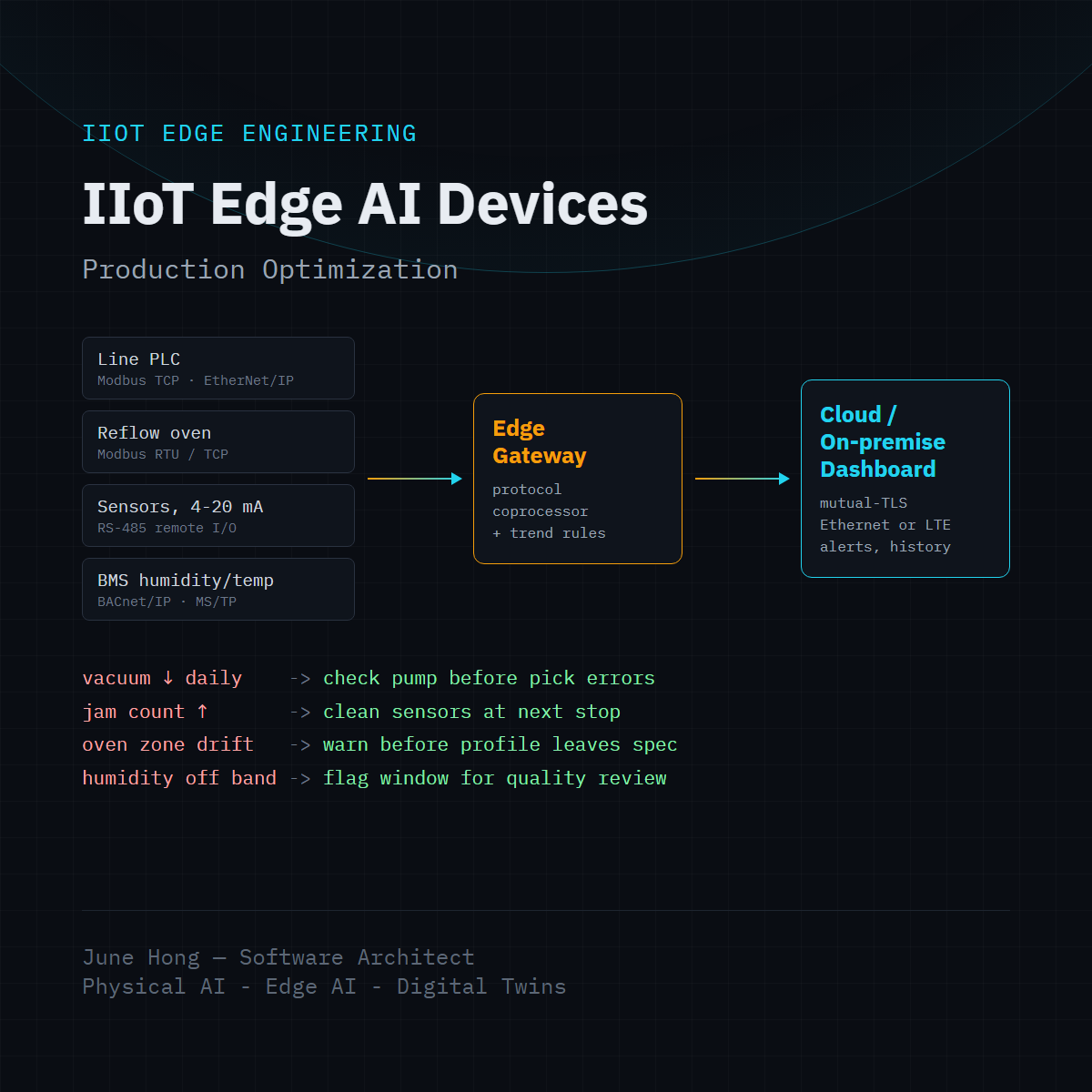
Fig. 1 — Field data from the SMT line flows through an edge gateway to a cloud or on-premise dashboard
Getting the Data Off the Line
An edge gateway paired with a protocol coprocessor speaks the industrial protocols the line already uses. Here's what each source can provide today:
| Source | Protocol | Typical data points |
|---|---|---|
| Line PLC and conveyors | Modbus TCP, EtherNet/IP | Board counts, transit times, run/stop state, jam and time-out faults |
| Extra sensors | Modbus RTU via RS-485 remote I/O | Photoelectric beams, 4–20 mA vacuum and air pressure, temperature probes |
| Reflow oven controller | Modbus RTU / TCP (model dependent) | Zone set-points and actual temperatures, conveyor speed, alarms |
| BMS / HVAC | BACnet/IP, BACnet MS/TP | Production-area humidity and temperature |
The remote I/O module deserves a mention. Sensors that were never wired to the PLC can be added on a cheap RS-485 module, without touching the PLC program. That keeps monitoring independent of line control, which matters to anyone who owns that PLC code.
Getting the Data Out Safely
The gateway connects to a cloud or on-premise dashboard over TLS with mutual certificate authentication. Each device has its own X.509 certificate, so only provisioned gateways can connect. It collects equipment status, process values, and counters only. It never needs product design data such as Gerber files or placement programs.
The uplink follows the site's IT policy. Where outbound OT traffic is allowed, the gateway uses plant Ethernet or Wi-Fi. Many electronics manufacturers keep production equipment off the corporate network entirely. For them, a cellular variant sends line data out over its own LTE-M / NB-IoT link. Cellular IoT is low-bandwidth, so it suits status, alarms, and summarized trends rather than raw high-rate streams.
From One Timeline to Real Optimization
Once the data sits on one timeline, optimization gets concrete. These are the rules I'd start with. Each is defined together with the plant team, using data points confirmed on the actual line.
| What's watched | Trend | Action |
|---|---|---|
| Supply vacuum | Falls a little every day | Check the pump, filters, and leaks before pick errors start |
| Conveyor jams | Jam counts rise, transit times get longer | Clean sensors or belts at the next planned stop |
| Reflow zones | Actual temperature drifts from the set-point | Warn before the thermal profile goes out of spec |
| Room environment | Humidity or temperature leaves its band | Alert facilities and flag that production window for quality review |
| Compressed air | Low-pressure events | Alert before pneumatic faults stop the line |
Most of these aren't neural networks yet. They're trends, and trends are what you should ship first. They're cheap, explainable, and useful from the first week. Learned anomaly detection on the device comes later, once the data shows where a hand-written rule stops working. I wrote more about that trade-off in Traditional Algorithms vs. Edge AI Models.
Two Principles I'm Building In from Day One
- Be honest about the interfaces. Modbus, EtherNet/IP, and BACnet are the easy part. Placement and inspection machines usually expose data through IPC-CFX, IPC-HERMES-9852, or SECS/GEM, and those need joint engineering. Until then, the summary data these machines already share with the line PLC (placement count, error flags, state) is a practical start.
- Poll wisely. A gateway reading every few hundred milliseconds won't catch millisecond sensor edges. Let the PLC count and time the events, and let the gateway read the results.
Final Thoughts
AI-driven production optimization starts with plumbing, not models. Get the PLC, oven, sensor, and environment data onto one secure timeline, ship simple trend rules that maintenance actually trusts, and let the data tell you where a model will earn its place.